Five Questions to Ask Before You Pay for Medical Assistant Training in Austin
Five Questions to Ask Before You Pay for Medical Assistant Training in Austin
Most guides to Austin medical assistant training hand you a list of things to look for. This one hands you five questions to ask out loud — on the phone, on a campus visit, in the admissions email — plus what a solid answer sounds like. A program that answers all five in a sentence each is one you can evaluate. One that gets vague on any of them has told you something useful.
According to the U.S. Bureau of Labor Statistics, the median annual wage for medical assistants was $45,690, with employment projected to grow 13 percent from 2025 to 2035 — much faster than the average for all occupations (U.S. Bureau of Labor Statistics, Occupational Outlook Handbook, May 2025).
Key Takeaways
- Ask for numbers, not adjectives — hours, weeks, and dates are checkable in a way that “comprehensive” is not.
- Externship timing has more effect on your life than curriculum detail does.
- In a metro that runs from Georgetown to Kyle, campus choice is a scheduling decision more than an academic one.
- Get the list of what you physically hold at the end, in writing.
1. How Many Hands-On Hours Do I Get, and Where?
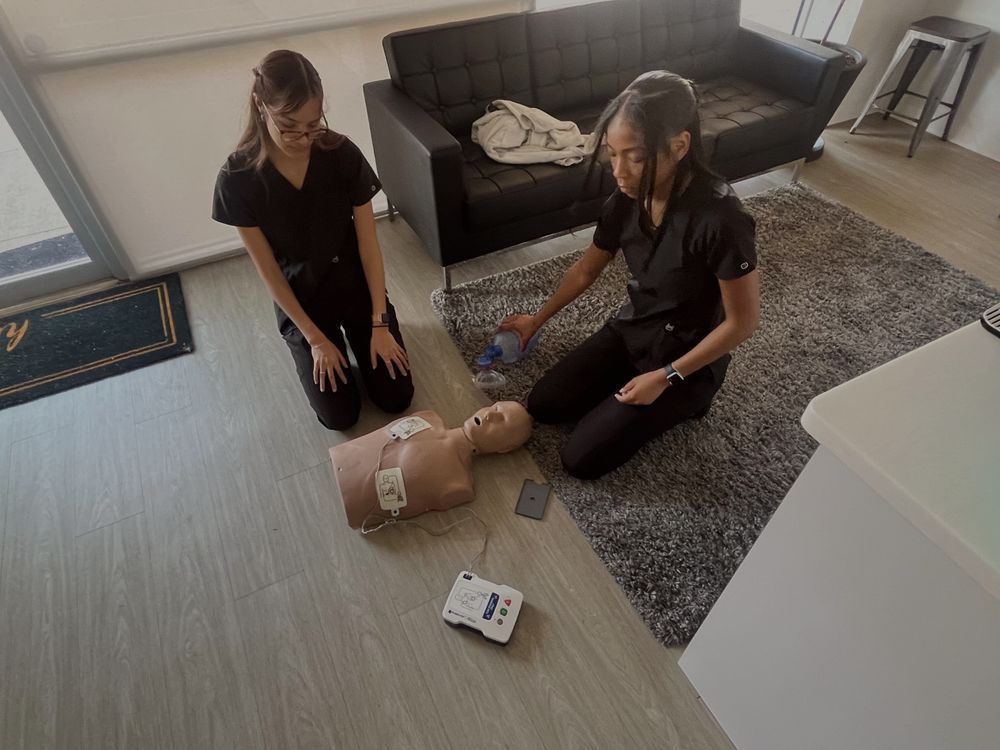
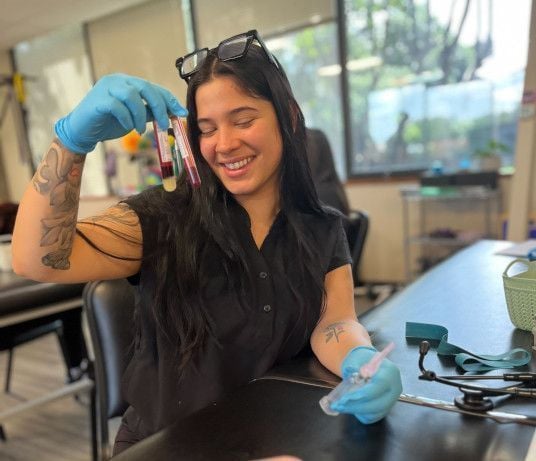
Ask for a number, then ask where those hours happen. There is a real difference between practicing a blood draw in a classroom with a training arm and practicing it in a working medical office with the equipment and workflow you will actually use.
Follow up with: how many students share an instructor during those hours?
A clear answer sounds like a number and a place. At Austin Medical Assistant School it is one 4.5-hour lab every Saturday inside a working medical office, across an 18-week program — venipuncture and order of draw, electrocardiograms, injections and medication administration, urinalysis and rapid testing, infection control and wound care, vital signs, and electronic health record charting.
The reason the number matters more than the syllabus is repetition. Nobody learns venipuncture from one demonstration.
2. When Does the Externship Start, and Who Finds It?
Two separate questions, and programs often answer only the first.
Timing first: at what point in the program do you become eligible? This matters because externship hours happen on weekdays in a working clinic, so the answer is also your deadline for sorting out work coverage. Here, students become eligible after week 8 of 18 — early enough that you have several weeks of warning.
Then ask who arranges the placement. Some programs place you. Some expect you to find your own. Many, including this one, sit in between: students are encouraged to find their own externship, and the team helps identify opportunities and assist with applications. None of those is wrong, but you should know which one you are signing up for before the week it starts.
3. Which Campus — and What Does That Do to My Week?
This question is specific to Austin, and it gets underweighted. Six campuses run the program: Cedar Park, Central, Georgetown, Kyle, Round Rock, and West Slaughter. Georgetown to Kyle is roughly fifty miles of I-35.
Since the Saturday lab is the only fixed in-person commitment, campus choice is mostly a question of which drive you can sustain on a weekend morning for 18 straight weeks. It also tends to shape externship geography, because placements generally land near where you train — which affects your weekday driving during the second half, when traffic is a real factor rather than a hypothetical one.
Pick for the commute you will be making in week 12, not the one that looks fine on a map.
4. What Do I Actually Hold at the End?
Ask for the specific list. Not “you’ll be certified” — the actual items.
Graduates of Austin Medical Assistant School receive a certificate of completion and a BLS (CPR) card, and hold the NHA Certified Clinical Medical Assistant credential once they pass the exam. That exam is administered by the National Healthcareer Association, not by any school.
That last distinction is worth listening for. No program awards the credential itself; it prepares you to sit for someone else’s exam. A program describing certification as something it hands you has muddled something basic.
Worth knowing as context: Texas does not license or register medical assistants. The credential requirement comes from employers, and on clinical postings around Austin it is close to universal.
5. What Is the Total Cost, and How Does Paying Work?
Ask for the number and what it covers, then ask what the payment schedule actually looks like week to week.
Tuition is $4,490. You can pay in full before your start date, or use a payment plan: $1,950 down with weekly payments of $157.78 over 18 weeks, or $950 down with weekly payments of $213.33. Current terms are posted on the tuition page. Tuition Savings may be available depending on your start date; ask admissions what applies to yours.
The weekly structure exists because it maps to how most students are actually paid. Whatever program you are considering, ask whether the figure quoted is the whole figure.
Why These Five and Not a Longer List
Every program will tell you it is hands-on, flexible, and career-focused. Those words are free. Hours, weeks, dates, a list of credentials, and a payment schedule are not — they are checkable, and they are what your next six months will actually consist of.
Marisol ran a coffee shop off South Lamar for nine years and had never drawn blood. What decided it for her was not the curriculum page; it was learning that Saturdays were the only fixed commitment until week 8.
Frequently Asked Questions
How long does medical assistant training take in Austin?
Eighteen weeks here, plus however long you take to schedule and sit for the CCMA exam afterward. Other programs vary, so ask for the number of weeks and whether the externship is included in it or added on top.
Can I keep working while I train?
Most students do through the first eight weeks, since coursework is online and the only fixed commitment is Saturday. The externship phase is harder, because those hours fall during clinic business hours — most students adjust their schedule rather than leave a job.
Do I need healthcare experience to enroll?
No. No prior healthcare experience is required. Most students come from other industries entirely.
Does it matter which campus I choose?
Academically, no — the same program runs at all six. Practically, yes: it sets your Saturday commute and usually influences where your externship lands.
Getting Started in Austin
Five questions, five checkable answers. Ask them of every program you are considering, including this one, and the comparison stops being a matter of who writes the better brochure.
Ready to start your medical assistant career in Austin? Explore the Austin Medical Assistant School program and take the first step today.
You're only a few months from the medical assistant career you deserve.